



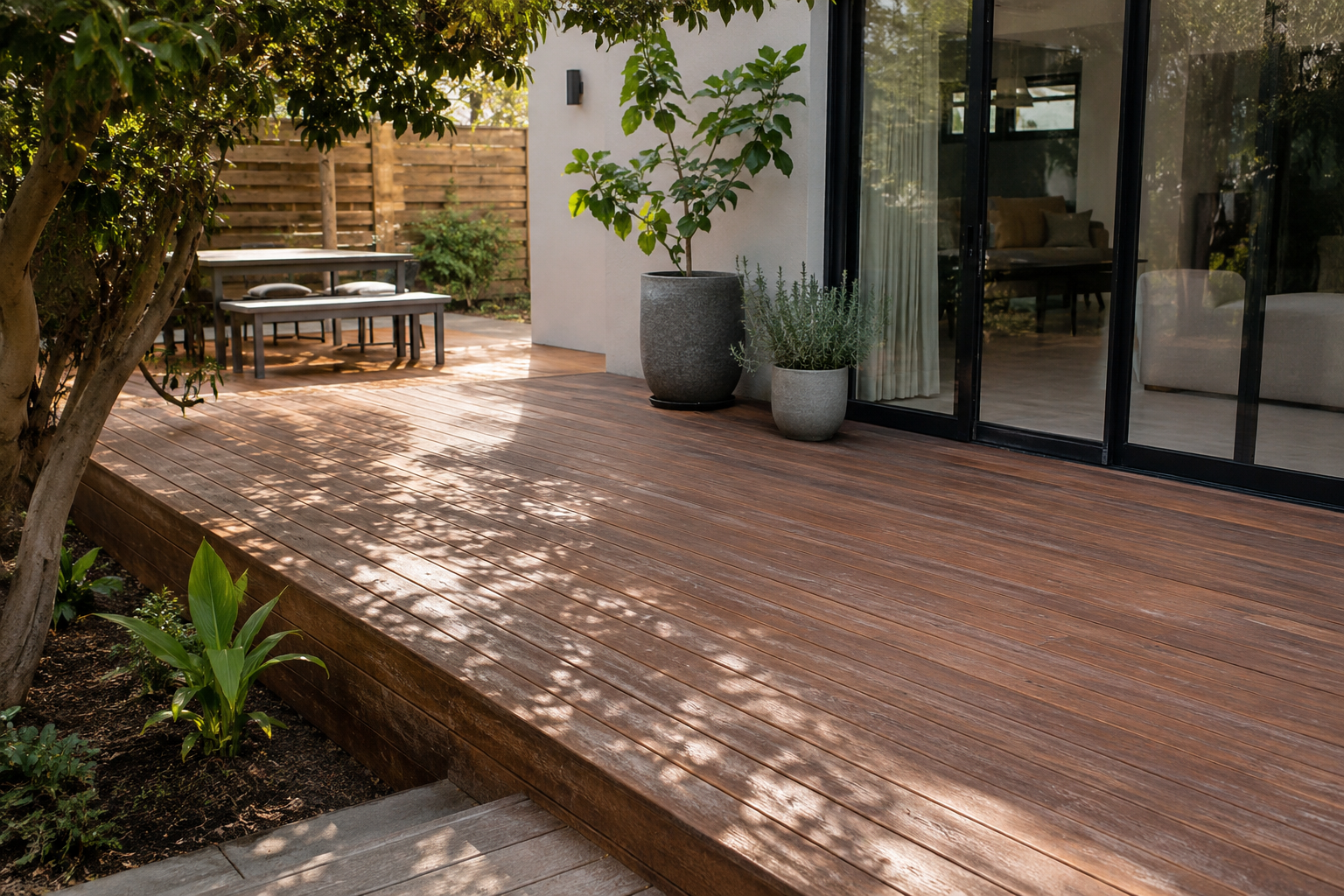
Installing a deck can completely change how an outdoor space is used.Â
An ordinary patio can become an entertainment area, a garden can gain a raised seating platform, and a swimming pool can be surrounded by a practical surface that connects it to the rest of the property.
The cost of decking in Cape Town depends on the size of the installation, the material selected, the design, the supporting structure and the conditions at the property.Â
A straightforward ground-level timber deck will generally require a different budget from a raised hardwood deck with stairs, balustrades and additional features.
The material is often the first decision homeowners consider, but it is only one part of the overall installation.Â
Understanding the different components of a decking project makes it easier to plan your budget, choose the right design and decide where to invest.
Planning a New Deck?
Tell us about your outdoor space, approximate dimensions and preferred decking material. Complete the enquiry form to start planning your installation.
Decking prices in Cape Town
Decking is generally priced according to the area being covered, with the cost influenced by the selected boards, substructure, installation labour and additional requirements.
The following ranges provide a useful starting point when budgeting for a decking project in Cape Town.
| Decking material | Approximate installed price per m² |
|---|---|
| Treated pine decking | R1,700–R2,200 |
| Garapa decking | R2,300–R3,200 |
| Balau decking | R2,250–R3,500 |
| Massaranduba decking | R2,400–R3,500 |
| Composite decking | R2,500–R4,500 |
The price difference between materials reflects factors such as the timber species, board dimensions, product specification, fixing requirements and installation method.
The final cost of a project also depends on what needs to be constructed beneath the decking.Â
A deck built over a suitable existing surface may have different structural requirements from one raised above uneven ground.
For larger installations, the layout can influence material usage and labour.Â
A simple rectangular deck is generally more straightforward to construct than a design incorporating several levels, curved edges, stairs or numerous cut-outs.
What does a 10 m², 20 m² or 30 m² deck cost?
The size of the deck is one of the most useful starting points when estimating the cost of a new installation.
A smaller deck may be sufficient for a seating area outside the house, while a larger platform can accommodate dining furniture, loungers and additional outdoor entertainment space.
Using the approximate installation rates above, the following examples illustrate how the budget changes according to the material and size of the deck.
Estimated decking costs by size
10 m² deck
-
Treated pine: R17,000–R22,000
-
Balau: R22,500–R35,000
-
Composite: R25,000–R45,000
20 m² deck
-
Treated pine: R34,000–R44,000
-
Balau: R45,000–R70,000
-
Composite: R50,000–R90,000
30 m² deck
-
Treated pine: R51,000–R66,000
-
Balau: R67,500–R105,000
- Composite: R75,000–R135,000
These examples demonstrate how the selected decking material can influence the overall investment.
A 10 m² deck may be suitable for a compact patio, but increasing the area to 20 m² or 30 m² creates more room for furniture, movement and entertainment.Â
The additional space can make the deck more practical, particularly where it connects the house to a garden or swimming pool.
The shape and design also matter. A larger deck with a simple layout may be easier to construct than a smaller deck with complicated corners, multiple levels and detailed finishing.
Discuss Your Decking Options
Complete the form below and Premium Decking will get back to you to discuss your outdoor space.
Choosing between timber and composite decking
The choice of decking material affects the appearance, initial investment and ongoing care of the finished installation.
Timber offers natural grain, texture and colour variation, while composite decking provides a manufactured finish with different surface and board characteristics.
The right choice depends on the appearance you want, the conditions in which the deck will be installed and how you intend to maintain it.
Treated pine decking
Treated pine is generally a more budget-friendly decking option and can be suitable for patios, garden platforms and outdoor entertainment areas.
Its affordability can make it attractive for larger projects where the total surface area has a significant influence on the budget.
Pine decking can also be incorporated into a range of outdoor designs, from straightforward ground-level platforms to more elaborate layouts.
Timber does, however, require ongoing care.Â
Cleaning and maintaining the surface helps preserve its appearance, while appropriate finishing products can be used according to the timber and installation requirements.
The initial investment is only one consideration. Homeowners should also think about the maintenance they are comfortable undertaking over the years.
Balau decking
Balau is a hardwood selected for its natural appearance and distinctive grain.
Its colour variation gives outdoor spaces a warm, timber finish that works well with gardens, paving, masonry and other natural materials.
Balau is often considered for decks where the appearance of hardwood is an important part of the design.Â
The board dimensions, timber specification and installation details contribute to the overall cost.
A hardwood deck should also be planned with appropriate spacing, fixing methods and finishing considerations.Â
These details help create a finished surface that is suitable for the installation and its environment.
Garapa decking
Garapa is another hardwood option, commonly associated with a lighter golden appearance.
It can complement outdoor spaces with lighter walls, stone finishes, contemporary architecture or landscaped gardens.
The final appearance of Garapa depends on the selected boards and the finishing treatment.Â
Natural timber variation means that the colour and grain won’t necessarily be identical across every board.
Its cost depends on the timber specification, dimensions, installation requirements and the structure supporting the deck.
Massaranduba decking
Massaranduba has a rich reddish-brown appearance that can create a striking finish in an outdoor entertainment area.
It may suit homeowners who prefer deeper timber tones and a natural hardwood surface.
The density and characteristics of the timber influence installation requirements, including cutting and fixing.Â
The selected board specification and supporting structure also contribute to the cost.
Composite decking
Composite decking is manufactured using a combination of materials, commonly including wood fibres and polymers.
Different product ranges offer different colours, textures, board profiles and fixing systems.Â
These differences influence both the appearance and the installation requirements.
Composite decking is often considered by homeowners who prefer a manufactured finish and want to reduce the routine timber finishing associated with traditional wooden decking.
It still requires cleaning and appropriate care, but its maintenance requirements differ from those of timber.
The initial price can vary considerably depending on the product selected.Â
Board dimensions, surface finish, construction, accessories and installation methods all influence the final cost.
Timber and composite decking each offer different advantages in terms of appearance, durability, maintenance and cost, so the best choice depends on what matters most for your outdoor space.
Timber and composite decking differ in several important ways that can influence your decision, particularly when considering long-term maintenance and overall value.
The structure beneath the decking
A finished deck consists of more than the boards visible from above. The supporting framework plays an important role in the installation and contributes to the overall cost.
Depending on the design, the structure may include joists, bearers, posts, foundations and other supporting components.
The arrangement and dimensions of these components depend on the deck’s height, layout, ground conditions and intended use.
Ground-level decking
A deck positioned close to the ground may have relatively straightforward structural requirements, particularly where the existing surface and levels are suitable for the installation.
However, the area still needs to be assessed to determine how the framework will be supported and how moisture and drainage will be managed.
A ground-level deck may be installed over an existing patio or another prepared surface, depending on the conditions at the property.
Raised decking
Raised decks introduce additional structural considerations.
The framework may need to accommodate changes in ground level, provide support at greater heights and incorporate additional components.
The height of the deck can also affect access, stairs and the design of its edges.
A deck extending over a sloped garden may require a different supporting arrangement from a platform built on relatively level ground.
These differences can influence both the materials required and the installation work involved.
Uneven ground and site preparation
Ground conditions can have a substantial influence on the cost of decking.
An uneven garden may require adjustments to the supporting structure, while a site with restricted access may affect how materials are transported and handled.
Existing paving, drainage points, walls, landscaping and other structures also need to be considered when planning the installation.
The proposed deck should fit the property rather than simply being designed around a square-metre calculation.
How the design affects decking costs
The layout of a deck can influence the amount of material required and the time needed to complete the installation.
Simple designs tend to have more straightforward board arrangements and fewer complicated cuts. More detailed layouts require additional planning and construction.
Rectangular decks
Rectangular decks are often practical because their layout can make efficient use of standard board lengths.
The structure is generally easier to arrange, and the design may require fewer complicated junctions or finishing details.
A straightforward deck can still be large, elevated or constructed using expensive materials. Its simplicity relates to the layout rather than necessarily making the entire project inexpensive.
Multi-level decks
Multi-level decking can create separate areas for dining, lounging or access to the garden.
Different heights can also help a deck work with the existing landscape, particularly where the property has slopes or changes in elevation.
However, every level introduces additional construction considerations.Â
The supporting structure, transitions, steps, edges and connections between the different sections must be planned together.
The additional detailing and construction work can increase the cost compared with a single-level deck.
Curved edges and custom layouts
Curved decking, diagonal board arrangements and unusual shapes can create distinctive outdoor spaces.
These designs may require additional cutting, careful material planning and more installation time.
The amount of waste can also differ from that of a straightforward rectangular layout, depending on the shape and board arrangement.
If the design includes several cut-outs or areas that need to fit around existing structures, those details should be considered when estimating the material requirements.
Discuss Your Decking Options
Complete the form below and Premium Decking will get back to you to discuss your outdoor space.
Additional features that can increase the budget
Decking is frequently combined with other outdoor features to create a complete entertainment area.
These additions can improve the functionality and appearance of the space, but they should be included in the planning process because they affect the materials, design and construction work.
Stairs and access
Raised decking may require stairs to connect the platform with the surrounding garden, patio or pool area.
The cost depends on the height, width, number of steps, materials and layout.
The position of the stairs can also affect how the deck is used.Â
A staircase placed near a garden path may provide convenient access, while a different arrangement may be more suitable for connecting the deck to the pool.
Where stairs are required, they should form part of the original design rather than being treated as a separate finishing detail.
Premium Decking offers outdoor wooden stairs for projects where wooden access steps are required.
Balustrades
Balustrades can form part of the design of a raised deck and may be required depending on the installation and applicable requirements.
Their cost depends on the length of the edges, the design, materials and the installation details.
A deck with multiple exposed sides may require more balustrade work than one positioned alongside a building.
The style of the balustrade also influences the appearance of the finished deck.Â
Wooden balustrades can complement a timber installation and create a consistent finish across the outdoor area.
Explore wooden balustrades when planning edge protection and finishing details for your deck.
Pergolas and shade
A pergola can create a more defined outdoor entertainment area and provide a framework for shade.
The cost depends on its size, design, materials, supports and construction requirements.
Combining a pergola with decking can create a cohesive outdoor space where the seating area, structure and flooring work together.
Planning both features at the same time allows their positions and dimensions to be coordinated.
Premium Decking also offers wooden pergolas for outdoor areas where a timber shade structure is being considered.
Built-in seating and planters
Built-in seating and planters can make a deck more functional without requiring additional freestanding furniture.
Seating can be positioned around the edges of the deck or incorporated into the layout to create dedicated gathering areas.
Planters can help integrate the deck with the surrounding garden, although their position, drainage and weight should be considered during the design.
These features require additional materials and construction work, so including them in the initial plan helps establish a more realistic overall budget.
Pool decking costs in Cape Town
Decking around a swimming pool requires careful consideration of the pool layout, surrounding space and intended use.
The amount of decking required can vary considerably.Â
A narrow walkway around the pool may be relatively small, while a large entertainment area could include space for loungers, outdoor furniture, access routes and seating.
The material selected also influences the cost. Timber and composite decking have different specifications, installation requirements and maintenance considerations.
The design must account for the pool itself, including its edges, existing coping, equipment, drainage and access points.
Premium Decking provides pool decking for outdoor areas where the deck forms part of the swimming pool environment.
Decking around an existing swimming pool
Installing decking around an existing pool involves working with the layout and conditions already present.
The project may need to accommodate existing paving, pool coping, pipes, drainage points and equipment.Â
The deck should also allow access to areas that need to remain accessible for maintenance.
The position of the decking can influence how people move between the pool, the house and the surrounding entertainment area.
For example, a deck designed primarily for pool access may require a different layout from one intended to accommodate dining furniture and a larger seating area.
The dimensions should therefore reflect how the space will actually be used rather than simply covering as much ground as possible.
Replacing an existing deck
Replacing an old deck may involve additional work depending on the condition of the existing installation.
The old boards may need to be removed, and the supporting structure may need to be assessed before new decking can be installed.
If the framework remains suitable, it may be possible to retain certain components. However, damaged, deteriorated or unsuitable structural elements may need to be replaced.
The cost of replacement therefore depends on the condition of the existing deck and the work required to prepare it for the new installation.
When repairs may be sufficient
Not every damaged deck needs to be completely replaced.
If the problem is limited to individual boards, surface deterioration or certain minor defects, repairs may be an appropriate option.
The condition of the supporting structure is particularly important.Â
A deck with sound structural components may require less extensive work than one where the framework or connections have deteriorated.
Premium Decking provides decking repairs and maintenance for existing decks, including maintenance and repair work where appropriate.
When replacement may make more sense
Replacement may become more practical when deterioration is widespread or when the existing structure no longer suits the property’s requirements.
For example, a homeowner may want to change the material, extend the deck, alter the layout or improve access to the garden or pool.
Replacing the deck can also provide an opportunity to incorporate features that weren’t included in the original design, such as stairs, seating, a pergola or additional entertainment space.
The decision should be based on the condition of the existing installation and the intended improvements rather than the appearance of the boards alone.
Request a Decking Quote in Cape Town
Ready to plan your outdoor space? Complete the enquiry form with your location, approximate deck size and preferred material to get started.
Timber decking maintenance and ongoing costs
The cost of installing decking is only part of the long-term investment.
Timber decking requires care to maintain its appearance and condition. The maintenance requirements depend on the timber, exposure, finish and use of the area.
Sunlight, rain, moisture, dirt and regular foot traffic can affect the surface over time.
Depending on the timber and finishing system, maintenance may include cleaning, sanding, sealing or applying an appropriate treatment.
A deck exposed to the elements may require different attention from one positioned in a more sheltered area.
Composite decking has different maintenance requirements.
Although it generally doesn’t require the same routine timber finishing, it still needs cleaning and appropriate care.
When comparing materials, consider how much time you are prepared to spend maintaining the deck and how you want it to look as it ages.
Why decking quotations differ
Two quotations for decks of the same size can have very different totals.
The difference may be related to the material, supporting structure, design, site preparation, access or additional features included in the work.
One project may involve a simple platform over an existing surface, while another may require elevated supports, stairs, balustrades and extensive preparation.
The decking material itself can also differ in specification, board dimensions, profile and fixing requirements.
When comparing quotations, look at the complete scope of the installation rather than only the final amount.
A useful quotation should make it clear what is being installed, which materials are included, what supporting structure is required and whether additional work forms part of the project.
This makes it easier to compare proposals and understand the differences between them.
Planning your decking budget
Before requesting a quotation, it helps to establish a few basic details about the project.
The approximate dimensions of the area will provide a starting point for calculating the decking requirements.
Photographs can help show the existing surface, ground levels, access and surrounding structures.
The material you prefer is another important consideration. If you’re unsure whether timber or composite decking is the better option, comparing the appearance, maintenance and installation requirements of each can help narrow your choices.
Think about how you intend to use the space as well. A small seating area may have different requirements from an outdoor dining space, pool surround or large entertainment deck.
Additional features such as stairs, balustrades, pergolas and built-in seating should also be considered early.
Having these details available can make the initial enquiry more useful and help establish the requirements of the project.
Finding the right decking for your property
The cost of decking in Cape Town depends on the complete installation rather than the surface area alone.
Material selection, deck size, layout, ground conditions, supporting structure and additional features all contribute to the final budget.
A simple deck can provide a practical outdoor space without unnecessary complexity, while a larger design can incorporate different areas for entertainment, relaxation and access to the garden or swimming pool.
Timber and composite decking offer different appearances and maintenance requirements, so the choice should reflect the way you want to use the space and the investment you’re comfortable making.
Planning these details before construction helps create a deck that fits the property, functions well and makes the most of the available outdoor area.
Premium Decking installs timber and composite decking across Cape Town and surrounding areas, including the Northern Suburbs, Southern Suburbs, Atlantic Seaboard, West Coast, Helderberg and Winelands.
Discuss Your Decking Options
Complete the form below and Premium Decking will get back to you to discuss your outdoor space.

Comments are closed